Saturday, November 19, 2011

10 Things About Wicca That Wiccans Should Know


1. Gerald Gardner, known as the father of Wicca, never actually used the word "Wicca" nor "Wiccan". He referred to his religion as "witchcraft" or "the Old Religion", and its followers, "the Wica". Ironically it was from his adversary, Charles Cardell,  where the word "Wicca" actually came from.


G.B.Gardner and an unfortunate chap. 


2. "Wicca" is an Old English word simply meaning "witch". In the middle ages this word is pronounced as "witcha". Whether it also denotes the meaning of "wise" is still largely debatable in the field of etymology.

3. While a sabbat is a gathering of witches for the purpose of religious celebration of the seasons, an esbat is a gathering of witches for any other occasion. It does not necessarily have to fall on a full moon, nor does it even have to be religious at all.


"Wiccans" of the "Alexandrian" tradition - words in quotes were not yet 'invented' at the time of this photograph. Here a coven of witches dance around a magic circle lead by self-proclaimed "King of the Witches", Alex Sanders. 


4. Gardner was initiated into the New Forest coven - not the Black Forest coven. The Black Forest tradition would be established many years later by the American witch Silver Ravenwolf.

5. Only four of the sabbats are based on ancient Celtic festivals: Samhain, Imbolc, Beltane and Lughnasadh. The Celtic names given to the sabbats are a fairly new addition, in the older books they are simply called Halloween, Candlemas, May Eve, and Lammas. Yule and Ostara are based on Germanic celebrations.  Mabon and Litha didn't get their names until the 1970's. Gardner's coven originally celebrated only the four 'Celtic' feasts. Celebration of the solstices and equinoxes were added later thanks to the influence of the modern druidic movement.


American witches who made Wiccan history (clockwise from top left): Margot Adler, Aidan Kelly, Z Budapest, Selena Fox, Ed Fitch, Starhawk.


6. Hecate, a popular patron deity among Wiccans, while known as a triple-goddess, was never viewed by the ancient Greeks nor modern Hellenic reconstructionists as maiden-mother-and-crone. The same is true with the Celtic triple goddesses Brighid and the Morrighan. The concept of the maiden-mother-crone triplicity is a modern and Wiccan concept and was introduced to the world by the poet Robert Graves in his pseudo-anthropological book "The White Goddess".

7. The athame is used for casting a circle, calling the quarters, and drawing the pentagram on the air - but not for invoking the God and the Goddess. The wand, which is a symbol of the spirit and the connection with the higher world, is much better suited for this purpose.  Pointing a sharp weapon to someone isn't particularly a respectful gesture. (See photo of Gardner above.)

The magician - raising the wand and connecting with the divine source.


8. "All gods are one god, and all goddesses are one goddess" is the general theistic philosophy of Wicca, popularized by occultist and psychiatrist Dion Fortune. Some Wiccans believe that this is the widespread belief among all Pagan religions. But this is actually closer to the theistic belief of the Hindus (monistic), than that of classical Paganism (polytheistic). While this Jungian concept of gods remains popular today, many other pagans are polytheists (all gods are not one, but separate identities), pantheists (all is god), panentheists (all is in god), non-theists (no gods, just spirits), and even atheists (no gods at all).

A note from a reader:  "...The diamond theory, although usually taught in many covens, especially during Outer Court training, is not Wiccan theology. That's propagated by most authors. In actuality, Wicca (that is, the Traditional side aka "original" Wicca) is an orthopraxic system. In other words, practice is more important than belief...they are not taught how to interpret the Gods or even their experiences in the Mysteries; rather, they are told that experiencing those things and practicing in the same, effective manner as the rest of the coven, is enough. It doesn't matter whether they are agnostics, polytheists, monotheists or even atheists..." - Alorer

9. Whether you like it or not, Aleister Crowley - also known as the Great Beast, Frater Perdurabo, 666 - did play a huge part in the formation of ideas and rituals of what was to be known as Wicca.


10. Gardner spent much years of his life living in India, South-East Asia and Ghana, both to earn a living and to study the indigenous religions of these lands, some of which he may have adapted into Wicca. The concept of 'skyclad', for example, came from the digambara practice of the Jains of  India - 'digambara' literally meaning 'sky-clad'. It might be possible that he has studied the  beliefs as well of our local tribes, as he wrote in his historic book:

"Pygmies now live in the same way in Central Africa, Malaya, New Guinea, the Deccan, Ceylon and the Philippines. I have known many of them and they all use poisoned arrows, and are thought to possess magical powers" -- Witchcraft Today


________________________________________________________


I have been around with our local Wiccan community for many years now, and at times I've been called to teach or lead a smaller group. I listed above some informational tidbits which I find that many among our local Wiccan-folk might not be aware of. While these may be dismissed as trivial I hope that it would encourage beginning Wiccans to learn more about the facts and history of their faith. Although I am no longer Wiccan it doesn't mean I no longer have to put my energy into learning about it. My path today has actually taken me even closer to its origins and beliefs.

Blessed Be!

Monday, October 31, 2011

Remembering the Departed

I have to admit, I still am afraid of death despite all the wisdom teachings that tell me I shouldn't be. I think fear of death comes with the survival instinct implanted by Mother Nature herself and it would just be unnatural not to be afraid of it. While not having fear may mean transcending my lowly animalistic self and my attachments to the mundane world, being afraid on the other hand means I am still finding reasons to live in this world despite all its faults, and it also makes me focus on what's really important and "live my life to the full" as the cliché goes.

My fear of death must have its roots from the fear of the unknown. I always say that death does not mean an end but rather a transition from one form to another. But what form comes next after life? The wisest gurus in history and scientists of recent years have given us ideas some of which I have adapted to believe, but deep inside I know that in the end they are all but a product of human experience and do not tell us what really is beyond there.

Samhain altar

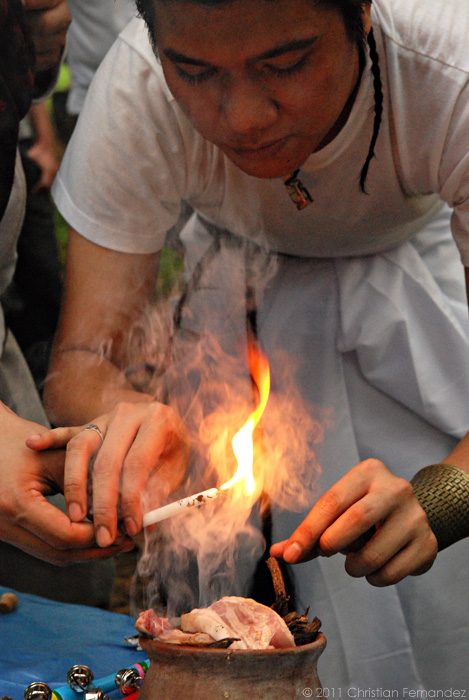
Three nights before undas, a beautiful ritual in the style of the Babaylans was led by Pol to honor the dead (umalagad). Food, flowers and dance were offered to the ancestors and the recently parted under the watchful eyes of the diwatas.

I think the ritual actually does more benefit to us, the living, than to the departed. In remembering them, we recall that part of us that has gotten lost when they left this world.


Samhain altar
Pol calls upon the spirits of the land.


Samhain altar
Candles are lit in remembrance of the dead. Names, photos and belongings of the departed are placed on the altar. 


Samhain altar


Samhain altar
Dancing and drumming around the altar.


Samhain altar
Ancestors of the babaylans were also honored during the ritual.


Samhain altar
Papa Legba.


Samhain altar
The feast is shared among the participants after the ritual.


Basbasan Nawa!

Saturday, October 29, 2011

The Lights of Diwali


Somehow I find myself always having an affinity with the goddesses of the arts and beauty. Yeye Oshun has been for me a symbol of gaiety and elegance. Brighid of the Gaels provides me with artistic inspiration and the energy to turn it into craft. Now I pray to Maha Lakshmi, the lotus goddess of wealth, for material providence and sustenance - because the reality nowadays is that art and beauty often costs money. I was also feeling a need to get acquainted with the vedic gods being that the Philippines is a part of Greater India.

The feast of Diwali is traditionally a time to make puja to Lakshmi. Being my first time to do puja I made a  research on the internet, and gods, the information was very overwhelming. Aside from the procedure and materials needed, it is also of course necessary to know what each act, gesture or material offering symbolizes to get a deeper significance out of it.

Thankfully Taj grocery in Makati sells a puja ritual kit for only 100 pesos, which is a great value considering it is packed with almost all the ingredients needed to do puja - different colored kum kum powders, incenses, camphor, mauli thread for decorations, janeau thread to be used as wicks for ghee lamps, a small bottle of anointing perfume, a small clay dish, a mantra booklet which is unfortunately written in devanagari, and lots and lots of different offerings.  

Even with all the preparation, I wasn't sure if I did everything 'right'. By the start of my puja prayer I just let go of my anxiety and let Maha Lakshmi know that I did all I can with utmost sincerity.

Drawing a swastika and lotus flowers on the kalasha, a symbol of Lakshmi


Offerings of kumkum-colored rice, seeds, nuts, grains, and a bottle of anointing oil.


Mixing aksatha (uncooked rice) with sindoor powder.


Lotus rangoli (mandala-shaped art) made from abeer, sindoor and gulal powder.


Aarti plate containing diyas (lamps). The flowers are more than just decoration, the coronets of baby's breath stems holds the lamps into place.


Making a panchamitra of milk, ghee, sugar, honey and yogurt (traditionally curd) to be used to bathe the Hindu statues.


The sacred mauli thread is worn during and after the puja.


The puja items are now prepared.


Burning camphor purifies the space.


The diyas are lit on the aarti plate.


Shri Maha Lakshmi sits on the rangoli wearing a garland. The rangoli sits on the purna-kalasha which is placed on kumkum-colored rice on a banana leaf. It is filled with water, coin, leaves and other items related to Lakshmi. Offerings are placed nearby.

A puja is also made to Ganapati.

दिवाली की शुभकामनाएं
Basbasan Nawa!

Friday, October 28, 2011

Welcome to My New Elemental Blog


The four elements

It's simpler, sleeker, and the best thing of all - the photos are bigger. Now it is easier to skip my prattle and just look at the photos - sometimes they tell the stories much better than my writing.

Also, one of the more important changes is that the categories have been streamlined and divided into four themes corresponding to the elements. Fire for matters of the spirit, Air for the study of magic, Earth for mundane pursuits of pleasure and Water for my emo-moments. Not only does it make my posts easier to classify but with this I might be able to see which of my four elements - body, mind, spirit and emotion - has been taking too much a big slice of the elemental cake. This is, after all, primarily a personal journal.

Have I been too busy pursuing materialistic happiness rather than spiritual contentment? Or have I been too focused on spirituality that I am no longer able to see the mundane realities?

Have I been too focused on scholarly studies that I have become an unfeeling intellect? Or have I been letting my emotions throw logic out of the window and fully take control of my actions?

Aggripa's pentagram man

It shows that the four elements can actually be a useful guidepost for living and not just esoteric stuff that Wiccans enumerate as points on the pentacle.

Thank you for your interest and time in visiting my blog. Whether we know each other or not, whether you are Pagan or not, whether you agree, disagree or do not give a hoot on what I write - I send you my blessings.

Basbasan Nawa!

Thursday, October 27, 2011

Earth Dance Manila 2011


After last year's memorable Earth Dance, the event has been much awaited by many people in the Pagan community.

This year's Earth Dance though  is a lot less Pagan-ish. The location was in the posh Bonifacio Global City which was nice enough, but I found it quite difficult to find and to get to. There were a lot less people who were able to attend than before, and much of the non-Pagan crowd were seemingly of the "upper class" type. Frankly I was missing last year's larger venue, as well as the Pagan Pride day, the Incan shamans and priestesses, the giant bonfire, the prayer tent, the overnighter, the globally synchronized prayer, etcetera.

That is not to say this Earth Dance isn't cool though. Dancing under the sky, barefoot, and together with friends old and new is always tons of fun.

The party ended early but with a flare. Fire lanterns were lit bringing our wishes to the sky. Only as soon as the last of the fire lanterns reached the clouds, the first drops of the coming storm began to fall. 

Blessed be Gaia!


These kids know how to jam.

El flamenquero.


Ate Bet and Khaye lets it all out.


I love the bamboo bikes. Mm, I love the sound of that. "bamboo bikes".

Goofing off on a palm tree.


Fire dancers and fire lanterns. (and a nice pair of legs)

Up, up and away!


Basbasan Nawa!

Tuesday, October 25, 2011

Before Blogging was Invented


I just got a very nice reward for cleaning my own room. I found my old journal from 15 years ago - written entirely in French. Ok, not entirely. The proper names are encoded in Cyrillic.

Even though my French has gotten a bit rusty now, I could see some grammatical errors. But wow, even now I couldn't believe at myself (yet feeling smug at the same time) for recording an entire school year of my life in a foreign language. It's really strange and interesting - and sometimes embarrassing - to read about what happened in your life more than a decade ago, even the seemingly insignificant events: my thoughts as I had my first taste of Dairy Queen's Blizzard, the happiest moments with friends I am no longer seeing now, my three consecutive strikes in duckpin bowling, the loneliest moments of college life and those times when I just sit in a corner of the canteen listening to my cassette tapes. I found myself sighing and cringing and giggling all at the same time. Here I am,  looking at me when I was yet so clueless with the world.

Oh, c'est la vie.

Sunday, October 23, 2011

Money, Money, Maneki Neko

 Nothing says "money, money, come to me" like a golden magical beckoning cat.

I was walking along a flea market when I saw a bunch of maneki nekos looking so cute waving at me. Not being able to resist their charm, I grabbed myself a small one and decided that I would pimp it up when I get home. I have made many magical charms in the past but none have been as kitschy as this.


The first thing I did was to find some flat container to put the cat on. Whilst scouring the supermarket I found a red plate with a polka dot pattern. It looks tacky but I think it’s very appropriate. Red is an auspicious color in China, and polka dots has always been associated with money among Pinoys. Along the border of the plate I glued some powerful magnets from my old broken earphones – for “attraction” of course.

I created an eight-sided gold and red ofuda (paper talisman) which I attached onto the cat’s waving arm with a piece of string and glue. The spirit food for the cat-servitor is coins and sometimes, a light tapping of fresh bills like what some superstitious merchants do to their goods when they receive their first sale of the day. I placed the cat facing the front door for good feng shui, and for good measure, I placed beside it a lump of jade for good fortune and an orgonite pyramid for generating positive energies. I named my cat “Kin’gyo”, meaning “goldfish” in Japanese.

Money still comes from hard work and self-discipline of course. But sometimes it does seem to appear magically right before you. There was one instance, for example, when I was cleaning my old bookshelf – and found my forgotten hidden stash of money which have fallen from one of the books.

I think my cat was trying to impress me.

Basbasan Nawa!

A Feast for Hekate of the Storms


Last year Aldrin, Pol, Ish and I came together to celebrate the feast of one of neopaganism’s most important deities. We honored Hekate as the lady of the underworld, and now we honor Her as queen of heaven. This time the intentions were less personal, the theme more significant, and on a superficial level, the ritual was less “darker” – no burning pharmakos, no chicken hearts; in broad daylight and incidentally under some threatening rain clouds.

“We ask of You to defend us now as you did then, to guard and watch over our land and our grain from ravaging storms and raping gales, from the terrible onslaught of heaven’s spears. ” Khairete Hekate Ouranie!

Pol performs  a traditional babaylan ritual to appease the indigenous spirits

Offerings to the spirits of the land

 
Aldrin leads the ritual.

Devotees of Hekate Ourania wearing white.


A "Greek" dance to celebrate the feast

Altar to Hekate Ourania


Basbasan Nawa!

 
Design by Free WordPress Themes | Bloggerized by Lasantha - Premium Blogger Themes | Affiliate Network Reviews