Sunday, February 10, 2013

Boracay - The Paradise Next Door

I was more curious than excited when my friend and I booked a flight to Boracay. Growing up in the Philippines - where everyone is just two hours away from a beach umbrella as they say - I believed I've seen enough beaches in my lifetime. I thought Boracay was just like any other white beach I've been to, only with cooler parties. Thankfully I was wrong.

The island may be tiny but it's packed with long stretches of Nat Geo cover-worthy scenery. At early mornings when the tide is lower, the scenery is even more surreal. My camera just couldn't handle it. It's more than just a feast for the eyes: the powdery white sand is so soft and just lovely to step on. Despite the tourist crowd that somehow takes away the idyllic-ness (idyllicity?) of the place, it still gives off that special vibe that takes your worries away. Watching the sunset, hearing the sea and the birds, is like a warm fuzzy blanket for the soul.

By the third day of our vacation, what peace the island had was even more disturbed by the ruckus of drums and shouts of "Viva Santo Nino!". It appears we have just arrived in time for the Ati-Atihan Fiesta (and to think I have left Manila amidst the chaos of the Feast of Nazareno). It seemed like an entire barrio paraded on the beach, and tourists have no qualms joining in for photo ops. Tropical beach, fiestas, and people having fun - heck, it almost felt like we were on a set of a tourism ad.

Enjoy these photos of seemingly endless stretch of luscious white sand beach...


....and crystal clear turquoise waters. 


It gets crowded in the middle of the beach and the water is green with algae, but it's still not that bad.


The sunset isn't bad either.


The grotto is the island's iconic landmark.


A parade along White Beach kicks off the province's week-long Ati-Atihan fiesta. 


The other side of the island stays serene.


Just me, helmet-diving, and pretending that I'm enjoying feeding the fishes while I'm nervously holding on to dear life.

Very nice looking, and very expensive, tribal trinkets sold by the beach.

Tuesday, January 1, 2013

New Year's Eve Witchery

While mother and sister were busy preparing dinner for media noche, I busied myself as well with new year's eve chores of the pagany sort. I was able to do a lot of stuff with my old stock of cinnamon and clove and half a dozen oranges.

Our house was filled with the sugary-sweet smell of citrus and spice as I made some old-fashioned glühwein (mulled wine) as first libation to the spirits for the year. I first got a taste of glühwein when I visited a German-themed Christmas market some weeks ago at the Mall of Asia. I found it quite odd-tasting at first but have gotten to like it after a few sips. My glühwein happily ended up tasting just as good as the one sold at the Christmas market. I decided that this shall be my official cool-season ritual drink.

Sugar and spice and everything nice.


At the Christkindlmarkt. December 9, 2012


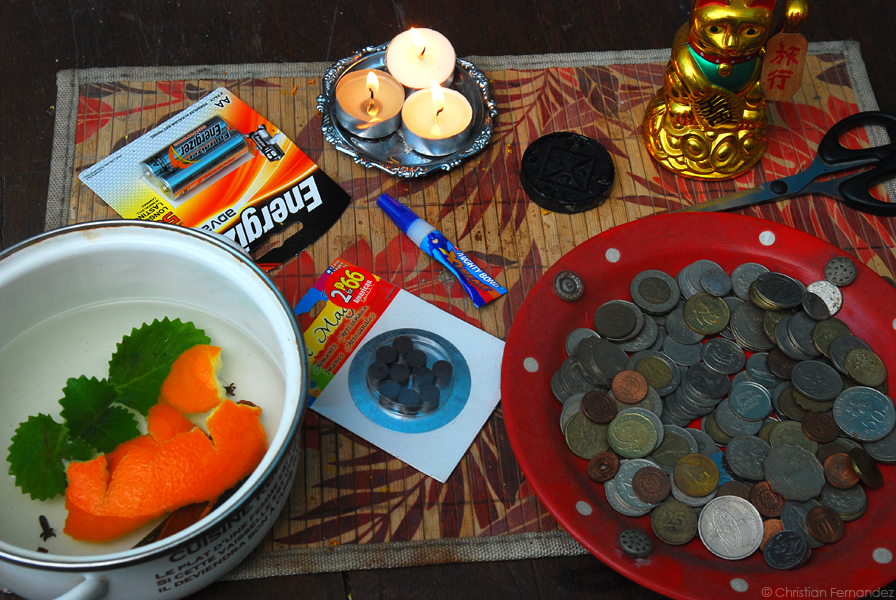
Kin-gyo, my mecha-servitor, brought me a lot of good things during the year. So instead of making a new one I just decided to upgrade my favorite money-maker. It's gotten a lot heavier now with all the coins I've been feeding it with. I replaced the batteries and the old speaker magnets with more powerful ones I bought from the home depot. I placed an orgonite disk at the center of the plate and placed the maneki-neko on top of it. I washed everything with an infusion of oregano, cinnamon, clove and orange peel steeped in warm mineral water. Now my ultra pimped maneki-neko is fresh for the year ahead.


Witching you a happy new year.


I made an anointing oil for Oshun as mini-libations for my weekly devotion. Unfortunately my lazy habit of not taking notes of the measurements kicked in and now I have totally forgotten the proportion of the ingredients. The recipe is quite simple though:
  • orange rind
  • cinnamon
  • clove
  • turmeric
  • nutmeg
I would have included some sunflower seeds and a few drops of honey but I'd like to keep the number of ingredients to five, just because it's a sacred number to Oshun.

Steep all of the stuff in canola or sunflower oil (I used canola) and shake daily for two weeks, drain, and it should end up being golden-yellow with a subtle citrusy scent.


Sunday, December 16, 2012

An Amulet and a Magic Potion for Oggún

A friend gifted me with a macuto, which is an odd-looking amulet connecting with the powers of a specific orisha. The one that I got of course is a macuto of Oggún, one my favorite great spirits.

 I love the smell of witchcraft in the morning. 
(The macuto is the green and black object with a cowrie shell.)

Amulets need to feed to be alive. So as food for the amulet I made a potion from herbs related to Oggún to anoint it with every Tuesday, Oggún's sacred day. I also reserved a bottle for anointing the altar image in my devotionals.

It's really been quite a while since I made some herbal stuff, I forgot how fun and delightfully messy it is. I was expecting the tincture to smell horribly because of the cumin and pepper, but I like how it turned out actually. Very strong yet very sweet smelling. I'm writing down the recipe for posterity's sake:


375 ml(lapad) Tanduay Rhum Dark
1 pack Fortune Menthol (20's)
10g bay leaves
25g anise seeds
20g black pepper (whole)
20g cloves (whole)
15g cumin powder
10g dried rosemary
A few drops of dragon's blood oil in each 75ml bottle


This kind of looks artsy.

Filtering, bottling and labeling. I had to buy these expensive (50 pesos) 15ml bottles from 
Beabi, due to time constraints and unwillingness to brave the Christmas shoppers at Divisoria.


Wednesday, October 31, 2012

Finding Fairies


The sea-serpent Bakunawa rises from the sea. 
Ink and colored pencil on Moleskine.

A block away from our house, there used to be an abandoned lot overgrown with grasses and bushes where there was a small hollow mound of shrubs that I could fit just right into. As a little kid, it was my secret sanctuary where I spend the early afternoons before my mother comes out to call me home for my siesta.

I believed my little sanctuary was a doorway between the magic fairy kingdom and our world. I never saw the fairies, but I knew they were there, protecting me from the evil monster (that stray mongrel that roams the bushes) and watching over me while I have my moments of sweet, silent, childhood happiness.


There is a garment factory standing over there now. And I now spend most of my waking hours in an office building - drowned in the electronic buzzes and drones of corporate machines, the bleep-bleep of telephones, the clackety-clack of keyboards, the voices of people around me muttering obscure business language.

The world seemed to become smaller as I grew older, and magic fairy mounds gradually got lost to concrete, glass and steel. It's the sad way of these times.

But once in a while, just when you get absorbed in the mechanical lifestyle, nature gives you those things: a butterfly fluttering happily through the rush hour traffic, a flower falling on you from a tree while you're waiting for the bus, a beautiful stray cat approaching you as you rest your legs by the sidewalk, a rare pink and yellow sunset that just commands attention through the double-glazed office windows.

Insignificant things, many a city dweller would think. But they make a "silly" pagan like me smile in silent delight and wonder. It's the kind of wondrous joy that slaps me back to my senses: 
Hey idiot, stop fussing about little stuff. You're so much bigger than that.

The fairies have not gone. The magic of this world is not lost to those who see with pagan eyes.

Tuesday, September 25, 2012

Tiocobrextio: An Autumnal Equinox Feast


The spirit of the north wind.

This is my first high-day ritual incorporating the Gaul hearth culture. One of the great challenges was to find the Gaulish equivalent for Mabon.

There is no clear evidence as to whether the Gauls celebrate the Automnal Equinox. In fact, it isn't very clear either whether there's a Gaulish word for "autumn". Scholars suggest the words uogiamos ("before winter"), or messus ("harvest"), but being in the Pacific tropics I wanted a less season-related word. I may be worshiping Gaulish gods but I'd like to keep my rituals relevant to the spirit of the land.

In the ADF dedicant manual, the Gaulish fall equinox festival is called Diocomrextios. I could hardly find any resources as to the origin of this word though, and it seems that the more correct, or at least the more popular reconstruction of the word is Tiocobrextio. However, far from what the manual says, this is not a festival specific to the fall equinox. In the Coligny calendar, an ancient artifact that has preserved the time keeping method of the Gauls, Tiocobrextio appears a few times throughout the Gaulish year, notably in the months of Simiuissonā (around May) and Ēdrini (around August). The word can either mean a "day of justice" (rextu, "law", "justice") or a "day of magic" (brixto, "magic", "incantation"). It works for me either way. A day for doing magic and for making things right.

It might be preposterous to make associations from Western astrology, but this being the time when the Sun enters Libra (the scales of Justice) makes it even easier for me to accept Tiocobrextio. The narrative may have changed but the theme remains largely the same with Mabon: transition, equlibrium, moderation.


Wheel and lightning. Votive offerings to the thunder god.

The Wheel of Taranis

Taranis is the Gaulish god of the skies and lord of storms. His most popular symbol is the wheel, which is associated with thunder. It is said that in the olden days, the sound of thunder was thought to be made by Taranis' chariot passing through the heavens. In this age of weather satellites, I see Taranis' wheels in tropical cyclones and in the shifting currents of the monsoon winds.

In the Philippines, the weeks following the fall equinox is a period of transition from wet to dry season. The cool, northern winds begin to prevail over the rainy, southwesterly winds. This also signals the peak of the migration of birds coming from the cold north going to the warmer south. The Philippine islands, sitting smack in the middle of the Asian and Australian continents, serves as a stop-over for the migratory birds, hence earning its title, "the avian archipelago".

I think it's a wonderful synchronicity that, in the old Filipino myth about the creation of man, the north wind, Amihan, is represented by a giant bird.


The boon of the tropics (clockwise starting from the big, spiky one): 
durian, rambutan, marang, lanzones and atis.

A Tropical Harvest

I usually just have wine and bread (and the occasional chocolate bar) for the celebratory feast, but from now on I am resolved to buy local seasonal produce. It's healthy; it's a good way to attune with the land; and it's quite cheap. For just a litte more than 200 pesos, I got enough food to share with family. Therefore, it's also one way to get the rest of the non-pagan household to join in with the celebration.

We may not have the corn-and-grain type, pre-winter harvest of the temperate lands, but we still do have seasonal crops. And it just happens that the fruits in season this time of the year are the really weird-looking and funky-smelling ones. Here's what I had in the shopping list:
  • Durián - Banned in malls, hotels and train stations because of its infamous, foul odor; and occasionally bludgeoning innocent people to death passing by under it's tree, this so-called "king of fruits" in the tropics is actually more like the super-villain of fruits.
  • Rambután - Very cheap and very nutritious. Soft, furry, and sturdy. I think they would make great stress balls too.
  • Márang - Exudes a strong smell even unopen, but the scent is more pleasant than Durian's. It's one of the most delicious and addicting fruit I've ever tasted.
  • Lanzónes - The grapes of the tropics. Sour and sweet and tastes a bit like lychee. I actually find more joy popping them open than eating them. 
  • Átis - A friend told me they look like dinosaur balls - as if he'd actually seen a pair. I like the taste, but the seeds get in the way from fully enjoying it.

My dedicant shrine. The sacred fire, a lamp with a triple flame. The sacred well, a pot filled with rain water. The sacred tree, represented by the goddess Danu with a symbolic tree design on her dress and standing on a triple spiral, a symbol of the convergence of the three worlds. 


Offerings and libations. I had Korean soju for ritual drink.


The dedicant shrine, post-ritual. 
Perth-Sowilo-Dagaz denotes a bright new beginning. 


Votive offerings to Taranis by a storm drain.


Basbasan Nawa!

Update - Oct 15, 2012: I think I'm changing the name to Cantlos - the name by which the Three Cranes Grove, an ADF grove which adopts the Gaulish hearth culture, calls this High Day. Cantlos is the last month of the Gaulish year, corresponding roughly to September, and literally means "the month of songs". This, being the month of my birth day, makes better sense for me. It's also a lot less mouthful (and sounds less pretentious) than Tiocobrextio. Why haven't I discovered this sooner? 

Tuesday, September 11, 2012

On Praying to the Ancestors


My ancestor shrine, inspired by the colorful egun'gun tradition of West Africa and Lucumi religion. It's also my first work on clay. The nine masks represent the collective spirits of my ancestors. Nine is the number of the orisha Oya, guardian of the dead. The pattern around the frame represents the river of life force (ashé) to which our spirits are bound to return.


Having come from the Llewellyn-Wicca variant of neopaganism, the idea of ancestor worship was unfamiliar to me when I first got introduced to it via a group of friends practicing African traditional religions.

Nevertheless I have made it a part of my practice as well. I felt that there is something important to it other than the obvious purpose of giving respect to the elders, which is very much a part of Asian culture, and other than redeeming myself from the guilt arising from worshipping the pagan gods of the Western world.

Over the years I have developed a peculiar posture whenever I say a prayer to the ancestors. I pray to the honored dead kneeling on the earth or on the floor while touching my head to the ground. I think this comes naturally being that the underground is the archetypal realm of the dead - just as people tend to look to the sky when praying to the gods.

What I notice about it is that it brings me to the safe and comfort of the fetal position. I have come to think of it as a little performance art of me returning to the womb and as a gesture of acknowledgement of my roots.

In this position I see nowhere but down and inward, and I am somehow compelled to give a deep, hard, inner look at myself:
This is me. This what I and my ancestors of blood and spirit have made. To honor my ancestors is to honor myself.

It's so easy to get lost in the clouds in this so-called spiritual journey. I pray to the ancestors to remind me of what I was and to become realistically aware of what I have become. While it is my love and faith to the gods that lift my hopes and ideals to heavenly heights, it is the honored spirits of the dead, powers beneath the earth that they are, that keep my feet on the ground.

Basbasan Nawa!


Friday, July 27, 2012

The Four Rules of a Magician

Because photo quotes are so in these days...


Wednesday, July 25, 2012

Holy Death


I have given up on the idea of karma, heaven, and a glorified afterlife a long time ago. I don't think I have any need of those in order to live righteously. I would rather that I do good things in this world simply for the sake of being human or for the pleasure of being kind, and not for the sake of some cosmic reward.

Religion doesn't have to sugarcoat death for me anymore. I've already seen her behind that make-up - and she doesn't  look very pretty. I have seen her for what she is and I embrace her existence. And it is precisely my pagan understanding of death that inspires me to live this life to the full and as virtuously as possible.

I think life has felt more meaningful once I got free from those wishful thoughts of immortality. Heaven can take its dangling carrot elsewhere. There already is a lush orchard around me.


Santa Muerte (ink & color pencils on Moleskine). Death as the mother of God. (Mater Theou). Death happens before life begins. The 3 Hebrew letters spell AIN ("nothingness"), which is the beginning of existence according to the Qabala. Read in another direction, it spells INA ("mother", in Tagalog). 

Tuesday, July 24, 2012

On Saturday Afternoons


One of my favorite hangout spots is that branch of Bo's Café inside the Powerbooks store in Greenbelt 4. Surrounded by books and the smell of coffee, it becomes my own little slice of paradise on many Saturday afternoons.

With a book on one hand and a warm porcelain mug on the other - that, or an oatmeal cookie - I let myself get lost into my inner worlds for many hours as I cozily sit on the wooden chair. (When I'm lucky, I get the sofa). 

On some occasions I would bring my notebook and a pencil to leisurely work on some artful sketches. I'm not very good in drawing, but nonetheless I find a special joy in it - as I always had since I was a wee little toddler. I think everybody loved making art when they were little, most people just forget about it as they grow older.


Once in awhile I would take a pause from reading or drawing to get absorbed into a particularly goosebumpy song playing on my iPod. Visual art and literature should always go together with music I believe, just as there should always be biscuits with your afternoon tea.

By late afternoon, that magical hour arrives when the golden rays of the sun glaringly shine through the glass panes of the café. My fellow coffee-lovers would then move their chairs to scurry away from the heat. I, however, enjoy the warmth on my skin, contrasting with the artificial coldness of the air inside the mall.

In these times where I spend most of my late afternoons in the prison of air-conditioned buildings, walled from the outside world by tinted glass and plastic curtains, to see and feel the sunset again is a most welcomed boon.


Basbasan Nawa!


Tuesday, April 3, 2012

The Nihil SIgil


Speaking of paper talismans, here is one that has been particularly useful for me these days. Well, techically it's not a sigil but heck, the name's got a nice ring to it.

I also call it the Triangle of Negation, or the "pigil" sigil ("pigil" being Tagalog for the word "prevent"). It's based on the classic ABRACADABRA charm. Unlike my other talismans, the words written on it are pretty obvious and straightforward. It's three sides nicely accentuates its correspondence to Saturn, whose number is three. In classical Western magic, Saturn is the planetary sphere to work with for purposes of banishment and destruction.

I admit, this was originally designed for 'evil' purposes, but actually it's doing me more good than harm.

Want to control your diet? Place it on the fridge.
Prevent yourself from impulsive spending? Put it on your wallet.
Fight your addiction to Facebook? Stick it onto the computer monitor.
Bam!

The paper was stained in a potion of black pepper, cumin, cinnamon, rust, bone dust and god knows what else (I forgot the rest). To make the most of Saturnian energies, it is to be made and charged on a Saturday, during the hours of Saturn, and preferably when the moon is in Scorpio.


Basbasan Nawa!

 
Design by Free WordPress Themes | Bloggerized by Lasantha - Premium Blogger Themes | Affiliate Network Reviews